
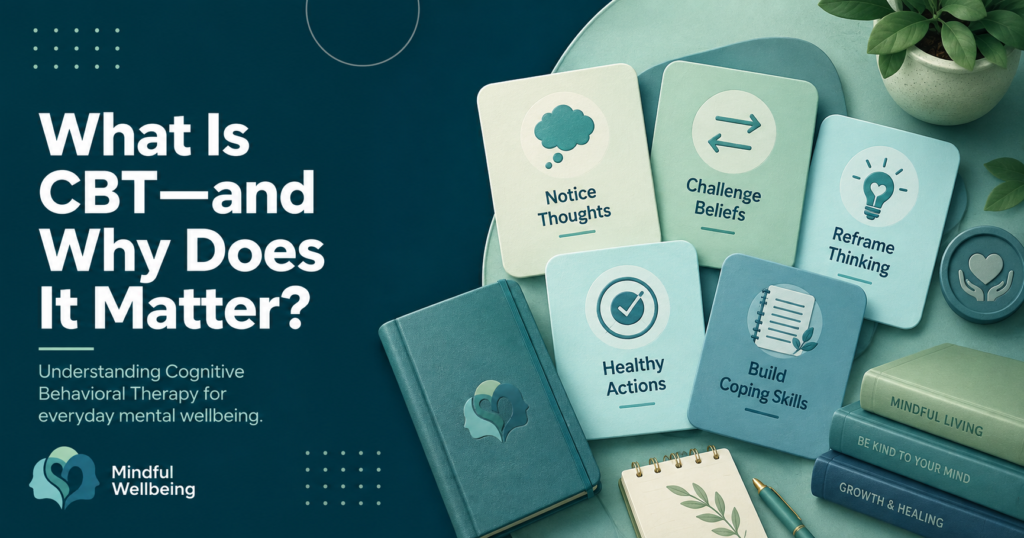
What Is CBT—and Why Does It Matter?
CBT is a structured psychological therapy that explores the relationship between thoughts, emotions, and behaviors.
An anxious student might think:
“If I don’t get a high grade, I have failed.”
A professional preparing for an important presentation might think:
“If I make one mistake, everyone will think I’m incompetent.”
These automatic predictions can increase anxiety and sometimes encourage avoidance.
CBT helps people identify unhelpful thinking patterns, evaluate them more realistically, change behaviors that maintain anxiety, and gradually face situations they have been avoiding.
The goal is not to eliminate normal anxiety. It is to prevent excessive anxiety from controlling everyday decisions and activities.
https://my.clevelandclinic.org/health/treatments/21208-cognitive-behavioral-therapy-cbt
Recent research continues to strengthen the evidence that Cognitive Behavioral Therapy (CBT) can help people manage anxiety by changing unhelpful patterns of thinking and behavior. This is especially relevant for adolescents, students, and working professionals, who may experience anxiety because of academic pressure, performance expectations, workplace demands, social concerns, uncertainty, or fear of failure.
This matters because anxiety can affect concentration, confidence, sleep, productivity, decision-making, relationships, academic performance, and work performance.
We’ll explain what recent research says about CBT for anxiety, what is happening now, what these findings mean for adolescents, students, and professionals, and what practical steps people can consider when seeking support.


What Does the Latest Research Tell Us?
1. CBT Continues to Show Benefits for Young People
A 2025 analysis evaluated 86 randomized controlled trials involving 98 CBT interventions for anxiety in children and adolescents. Researchers also investigated why treatment outcomes can differ between young people—an important shift toward understanding which CBT approaches work best for whom. (Read the study on PubMed)
2. CBT May Produce Measurable Changes Beyond Symptoms
Research highlighted by the National Institute of Mental Health (NIMH) found that children with anxiety showed significant symptom improvement after approximately three months of CBT. Researchers also observed changes in brain regions associated with cognitive control following treatment. (NIMH Research Update)
This does not mean a brain scan is needed to determine whether CBT works. Instead, the research provides scientists with additional insight into how successful psychological treatment may relate to changes in brain functioning.
3. Digital CBT Is Becoming an Important Research Area
For busy students and working professionals, accessibility matters.
A 2025 randomized clinical trial involving 351 adults with generalized anxiety disorder found that smartphone-delivered digital CBT produced greater reductions in anxiety than an active psychoeducation comparison.
For younger people, the evidence is more mixed. A 2025 systematic review found mobile CBT promising overall but noted that evidence specifically for anxiety remains less certain than for some other outcomes. (PubMed – Mobile CBT Review)
That distinction is important: digital CBT can be promising without every app or online program being equally effective.
4. Researchers Are Exploring Earlier Intervention
The 2026 Lancet Psychiatry study tested a pathway in schools where parents completed brief anxiety screening and eligible families were offered parent-led CBT with online and telephone professional support.
This reflects an important direction in mental-health research—recognizing problematic anxiety earlier rather than waiting until it seriously disrupts everyday functioning.
What Does This Mean for Adolescents and Students?
Anxiety among young people may appear as:
- Fear of exams or failure
- Excessive overthinking
- Avoiding presentations or class participation
- Perfectionism
- Difficulty concentrating
- Fear of being judged
- Worry about the future
- Reduced confidence
CBT can help students recognize thoughts such as:
“I will definitely fail.”
and learn to examine them more realistically:
“This exam is important, but one result does not determine my entire future. I can prepare and focus on what I can control.”
Recent evidence supports CBT as an important intervention for youth anxiety while also showing that treatment needs to be adapted to the individual rather than using exactly the same approach for everyone.
https://www.betterhealth.vic.gov.au/health/conditionsandtreatments/cognitive-behaviour-therapy
What Does This Mean for Working Professionals?
Workplace anxiety may involve:
- Constant worry about performance
- Fear of making mistakes
- Difficulty switching off after work
- Avoiding difficult conversations
- Overchecking work
- Presentation anxiety
- Stress around deadlines
- Perfectionism or self-doubt
CBT may help a professional recognize the difference between productive preparation and anxiety-driven thinking.
For example:
Anxiety-driven thought:
“If this presentation isn’t perfect, my career will suffer.”
More balanced thought:
“I need to prepare carefully, but I don’t need to perform perfectly to do my job well.”
Recent research into digital CBT may also be particularly relevant for working adults because flexible treatment formats could reduce some practical barriers to accessing psychological support.


What Should You Do If Anxiety Is Affecting Daily Life?
Research supports CBT, but this does not mean everyone experiencing stress automatically needs CBT.
Consider seeking professional psychological support when anxiety is persistent, difficult to control, or regularly interfering with studies, work, sleep, relationships, confidence, or normal activities.
A qualified psychologist can assess what is contributing to the anxiety and determine whether CBT or another evidence-based approach is appropriate.
You can also start by noticing three things:
Trigger → Thought → Response
For example:
Presentation → “I’ll embarrass myself” → Avoid presenting
Recognizing this pattern is often useful because CBT works not only on how a person feels, but also on the thoughts and behaviors that can maintain anxiety.
The Key Takeaway:
The important news is not that researchers have suddenly discovered CBT works. CBT already has a substantial evidence base.
What is changing in 2025–2026 is our understanding of how CBT can be personalized, delivered digitally, introduced earlier, and made more accessible to people experiencing anxiety.
For adolescents, this could mean better support for academic and social anxiety.
For students, it may mean learning healthier responses to exams, performance pressure, perfectionism, and fear of failure.
For working professionals, CBT may provide practical strategies for managing workplace worry, performance anxiety, and unhelpful thinking patterns.
The strongest message from current research is simple:
Anxiety should not be ignored when it begins controlling how you study, work, communicate, or live. Evidence-based psychological support can help.
Call-to-Action:
Is Anxiety Affecting Your Studies, Work or Confidence?
If anxiety, overthinking, academic pressure, workplace stress, or fear of failure is interfering with your daily life, professional psychological support may help you understand the pattern and develop healthier coping strategies.
Speak with a professional psychologist and explore appropriate psychological support.
Book an appointment: mentalawareness.info