
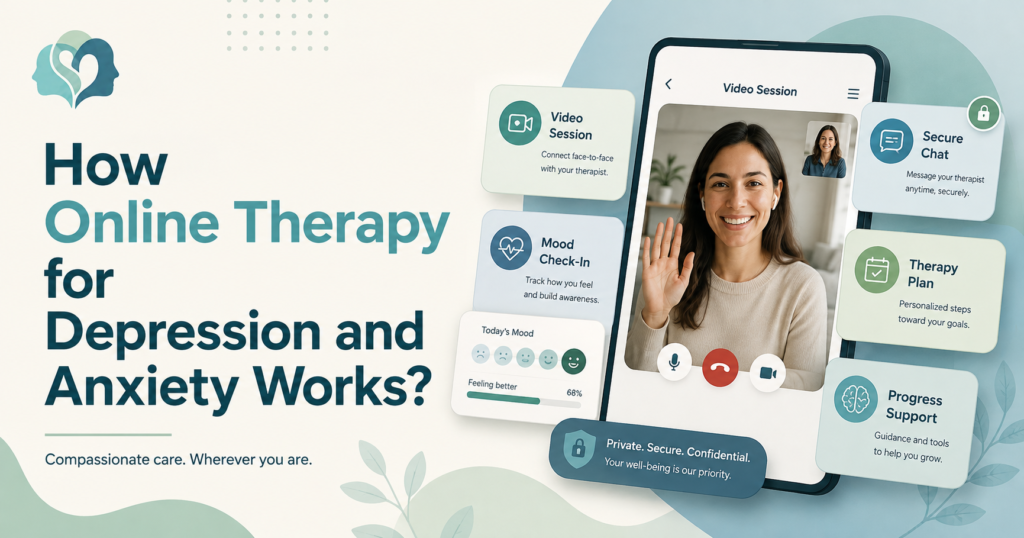
How Online Therapy for Depression and Anxiety Works
Introduction
Depression and anxiety can affect concentration, sleep, motivation, relationships, academic performance, and everyday responsibilities. Yet getting psychological support is not always easy because of distance, busy schedules, limited local services, or difficulty attending regular in-person appointments.
Online therapy for depression and anxiety provides a way to connect with a qualified mental health professional through secure video or other approved telehealth methods. The National Institute of Mental Health (NIMH) notes that virtual mental health care can be effective for conditions including depression and anxiety.
In this post, we’ll explain why online therapy for depression and anxiety is important, how online therapy works step by step, and provide 8 practical points to understand if you’re new to online psychological support.
https://missionconnectionhealthcare.com/mental-health/depression/online-therapy/.
What Is Online Therapy for Depression and Anxiety, and Why Does It Matter?
Online therapy is psychological treatment provided remotely by a qualified mental health professional, most commonly through video sessions. It may involve approaches such as Cognitive Behavioral Therapy (CBT), interpersonal therapy, behavioural activation, problem-solving therapy, or other evidence-based psychological interventions, depending on the person’s needs.
The World Health Organization (WHO) confirms that psychological treatments for depression may be provided in person or online, and identifies CBT, behavioural activation, interpersonal psychotherapy, and problem-solving therapy among effective approaches.
For anxiety disorders, WHO also states that psychological interventions can be delivered online and highlights CBT-based approaches as having strong evidence across several anxiety disorders.
Online therapy matters because it can make professional psychological support easier to access. However, it is important to understand that online therapy is a method of delivering treatment—not one specific treatment itself. The quality of care still depends on factors such as professional qualifications, appropriate assessment, the therapy being used, and whether virtual treatment is suitable for the individual.
https://psychiatryonline.org/doi/full/10.1176/appi.ps.201400477
How Online Therapy for Depression and Anxiety Works:
1. You Start by Seeking Professional Support
The first step is finding an appropriately qualified mental health professional or service.
Rather than choosing a service simply because it offers quick access, check the professional’s credentials, experience, therapeutic approach, and whether they commonly work with depression or anxiety.
This distinction is important because a general wellness app, chatbot, or self-help program is not automatically equivalent to professional psychotherapy. NIMH notes that although digital mental health technologies offer opportunities, the effectiveness and oversight of mental health apps can vary considerably.
2. An Initial Consultation Helps Identify Your Needs
Online therapy usually begins with an initial consultation or assessment.
During this conversation, the therapist may ask about:
- Current concerns and symptoms
- How long difficulties have been occurring
- Sleep, concentration and daily functioning
- School, university, work or relationship pressures
- Previous psychological treatment
- Current goals for therapy
The purpose is not simply to attach a label to someone’s experience. It is to understand what is happening, how it is affecting daily life, and what type of support may be appropriate.
Online therapy usually begins with an initial consultation or assessment.
During this conversation, the therapist may ask about:
- Current concerns and symptoms
- How long difficulties have been occurring
- Sleep, concentration and daily functioning
- School, university, work or relationship pressures
- Previous psychological treatment
- Current goals for therapy
The purpose is not simply to attach a label to someone’s experience. It is to understand what is happening, how it is affecting daily life, and what type of support may be appropriate.


3. The Therapist Develops a Treatment Plan
After understanding the person’s concerns, the therapist can develop an individualized treatment plan.
For example, one person experiencing anxiety may need help understanding anxious thinking and gradually confronting situations they have been avoiding. Someone experiencing depression may focus more heavily on rebuilding routines, increasing meaningful activities and challenging patterns of unhelpful thinking.
Treatment therefore should not follow exactly the same formula for everyone.
NIMH identifies CBT and interpersonal therapy among evidence-based psychotherapies used for depression and notes that psychotherapy can be effective when provided virtually through telehealth.
4. Regular Online Therapy Sessions Begin
Sessions are typically scheduled at agreed intervals depending on the treatment plan and individual circumstances.
During a session, the therapist and client may explore emotions, thoughts, behaviours, stressful situations and patterns affecting everyday life.
Although the conversation takes place remotely, structured psychological therapy still involves therapeutic goals and evidence-based techniques rather than simply discussing problems.
NIMH reports that virtual mental health care can be effective for conditions including anxiety and depression, although suitability can vary between individuals and situations.
https://www.sciencedirect.com/science/article/abs/pii/S0149763404000375
5. You Learn to Recognize Unhelpful Patterns
An important part of many therapies is developing greater awareness of connections between:
Situation → Thoughts → Emotions → Behaviour
For example, a person might interpret one mistake as evidence that they are going to fail completely. That interpretation may increase anxiety and lead them to avoid the situation altogether.
Therapy can help people examine these patterns more carefully and develop healthier ways of responding.
This is particularly central to Cognitive Behavioral Therapy, which is widely used in the treatment of depression and anxiety.
6. You Practice Psychological Skills Between Sessions
Progress usually does not happen only during the therapy appointment.
Depending on the therapeutic approach, a psychologist may encourage structured activities between sessions, such as:
- Recording thoughts or emotional patterns
- Practising coping or relaxation strategies
- Gradually approaching previously avoided situations
- Building healthier routines
- Scheduling meaningful activities
These activities help transfer skills discussed during therapy into everyday situations.
For anxiety, WHO notes that psychological interventions can help people learn new ways of thinking and coping and, where appropriate, gradually face situations that trigger anxiety.
7. Progress Is Reviewed Over Time
Effective therapy should have direction.
The therapist and client can periodically review questions such as:
Are symptoms changing?
Is everyday functioning improving?
Are therapy strategies helping?
Do the treatment goals need to change?
Progress does not necessarily mean that every difficult emotion disappears. A more realistic goal may be becoming better able to understand emotions, manage symptoms and function effectively despite occasional difficult days.
If progress is limited, the treatment approach may need to be adjusted or another type of professional support considered.
8. Therapy Moves Toward Maintaining Progress
Online therapy is not necessarily intended to continue indefinitely.
As people become more confident using the skills they have learned, sessions may increasingly focus on maintaining improvements and recognizing situations that could trigger previous difficulties.
The aim is to help the person develop strategies they can continue using beyond therapy.
For some people, psychotherapy alone may be appropriate. Others may require additional medical assessment or treatment. Decisions about medication or combined treatment should be made with appropriately qualified healthcare professionals rather than through self-diagnosis.
https://www.frontiersin.org/journals/psychiatry/articles/10.3389/fpsyt.2019.00759/full


Closing:
Online therapy for depression and anxiety works by bringing structured psychological treatment into an accessible virtual setting. It can involve professional assessment, personalized treatment goals, evidence-based techniques, regular sessions, practical exercises and ongoing monitoring of progress.
Research and major health organizations support virtual psychotherapy as a legitimate way of delivering mental health treatment for conditions including depression and anxiety.
The most important point, however, is that online does not mean one-size-fits-all. Effective psychological care should still be provided by appropriately qualified professionals and tailored to the individual’s needs.
If depression, persistent anxiety, overthinking, low motivation or emotional difficulties are interfering with daily life, seeking professional guidance can be an important next step.
Get Professional Psychological Support:
You do not have to manage persistent emotional difficulties without professional guidance.
Book an online consultation with a professional psychologist to discuss your concerns and understand which type of psychological support may be appropriate for you.
Book Your Appointment: mentalawareness.info
.